Community recipe
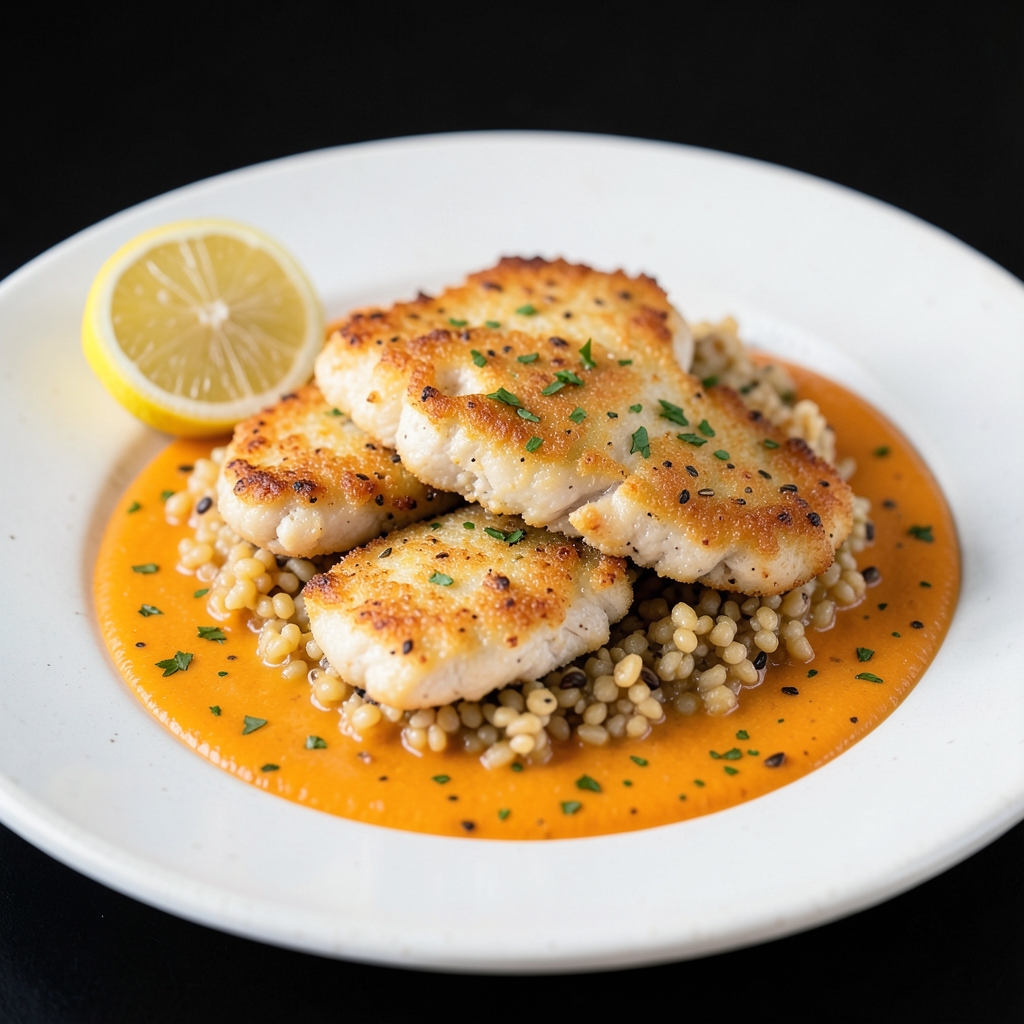
Golden Chicken Cutlets with Silky Carrot Sauce and Toasted Farro
Crisp-edged chicken cutlets are served over nutty toasted farro with a velvety carrot pan sauce brightened by lemon and finished with parsley. It is a weeknight-friendly plate with familiar flavors, a colorful vegetable-forward sauce, and enough texture to feel special.
- Serves
- 4
- Prep
- 20 min
- Cook
- 35 min
- Difficulty
- medium
Get ready
Ingredients
- 240 g pearled farro
- 720 ml waters
- 0.5 tsp salt
- 680 g boneless, skinless chicken breasts
- 60 g all-purpose flour
- 0.5 tsp black pepper
- 2 tbsp olive oils
- 30 g unsalted butters
- 1 yellow onion, peeled and finely chopped
- 300 g carrots, peeled and thinly sliced
- 360 ml low-sodium chicken broths
- 120 ml heavy creams
- 1 tbsp lemon juice
- 15 g fresh parsleies, washed, dried, and finely chopped
Make it
Instructions
- 01
Cook the farro
Set a medium saucepan, fine-mesh strainer, cutting board, chef’s knife, measuring cups, and a large skillet near your work area. Rinse 240 g pearled farro under cool running water until the water runs mostly clear. Put it in the saucepan with 720 ml water and 0.5 tsp salt. Bring to a boil over high heat, reduce to a steady simmer, and cook uncovered for 25–30 minutes, until the grains are tender but still pleasantly chewy. Drain well, return to the warm saucepan, cover, and let stand for 5 minutes. | Why: Rinsing removes excess surface starch, while resting lets the cooked grains finish absorbing moisture without becoming mushy.
- 02
Prepare and season the cutlets
While the grains cook, place a wire rack over a rimmed baking sheet. Pat 680 g boneless, skinless chicken breasts dry, then slice each breast horizontally into two even cutlets. If needed, gently pound the thick portions to about 1 cm thickness. Combine 60 g all-purpose flour, 1 tsp salt, and 0.5 tsp black pepper in a shallow dish. Press both sides of each cutlet into the mixture, shaking off the excess, and arrange them on the rack. | Why: Even thickness helps the poultry cook at the same rate, and a light flour coating creates a crisp surface while giving the sauce something to cling to.
- 03
Sear the cutlets
Warm the large skillet over medium-high heat for 2 minutes. Add 2 tbsp olive oil and heat for 30 seconds; it should shimmer but not smoke. Lay in the coated cutlets without crowding, working in two batches if necessary. Cook for 3–4 minutes on the first side and 2–3 minutes on the second, turning when the underside is deeply golden. Transfer the cooked pieces to the rack and continue until every piece reaches 74°C at the thickest point. | Why: A hot, lightly oiled skillet browns the coating quickly while the rack prevents the crisp underside from steaming.
- 04
Build the carrot pan sauce
Reduce the skillet heat to medium and add 30 g unsalted butter. When melted, add 1 small yellow onion, peeled and finely chopped, and cook for 3 minutes until translucent. Add 300 g carrots, peeled and thinly sliced, and cook for 5 minutes, stirring, until the slices begin to soften. Pour in 360 ml low-sodium chicken broth, scrape up the browned bits, and simmer for 8–10 minutes until the carrots are completely tender. Carefully blend the hot mixture with an immersion blender until smooth, or cool it briefly before transferring to a heat-safe blender. Stir in 120 ml heavy cream and 1 tbsp lemon juice, then simmer gently for 2 minutes. Taste and adjust with a pinch of the reserved seasoning if needed; the sauce should be silky, savory, and lightly tangy. | Why: Softening the vegetables before blending creates a naturally creamy texture, while the acidic finish keeps the rich sauce balanced.
- 05
Finish and serve
Fluff the rested grains with a fork and divide them among four warmed shallow bowls. Spoon the carrot sauce alongside and place the golden cutlets over the top. Scatter 15 g fresh parsley, washed, dried, and finely chopped, over the plates. Let the cutlets stand for 2 minutes, then serve immediately while the coating is crisp and the sauce is warm. | Why: A brief rest keeps the poultry juicy, and serving the sauce beside rather than over the coating preserves its crunch.
